lob-proc: Reconstructing Order Flow from Snapshots
A C++ snapshot parser, NATS pipeline, and browser heatmap for limit order books
Exchanges publish periodic order book snapshots — full depth-of-book state at a point in time. lob-proc diffs consecutive snapshots to reconstruct individual order events (add, remove, modify), streams them over NATS, and renders a live heatmap in the browser. The result is a real-time view of order flow without needing a direct market data feed.
Architecture
The system is a linear pipeline of four components, connected by NATS subjects:

- Feeder (Go) — a synthetic generator that publishes little-endian binary snapshots on
orderbook.snapshots(swap in a WebSocket exchange feed if needed). - Processor (C++) — subscribes to snapshots, diffs against previous state, emits granular order events to
orderbook.tbtin a compact binary format. The pairId is carried in the payload header. - Viz Server (Go) — bridges NATS to WebSocket. Subscribes to
orderbook.tbt, fans out to connected browser clients. - Browser (React/Canvas) — renders a scrollable, zoomable heatmap of order book depth over time.
Each component is independently deployable. The feeder and viz server are straightforward Go services; the interesting work happens in the C++ processor.
Snapshot Diffing
The processor maintains per-pair book state. On each new snapshot, it walks both the bid and ask sides comparing price levels against the previous state, emitting granular events for every change.
The core data structure is a packed 40-byte order struct:
// 20-byte header
struct Header {
    uint8_t  type;       // message type
    uint32_t pairId;
    uint64_t seq;        // sequence number
    uint32_t count;      // event count
    uint8_t  pad[3];
}; // 20 bytes
Show all 20 lines
// 20-byte header
struct Header {
    uint8_t  type;       // message type
    uint32_t pairId;
    uint64_t seq;        // sequence number
    uint32_t count;      // event count
    uint8_t  pad[3];
}; // 20 bytes

// 40-byte wire order
struct Order {
    uint32_t pairId;
    double   price;
    uint64_t time;
    double   qty;
    uint8_t  side;       // 0 = bid, 1 = ask
    uint8_t  type;       // 0 = add, 1 = remove, 2 = modify
    uint8_t  action;
    uint8_t  pad[5];
}; // 40 bytes
The critical problem in snapshot diffing is distinguishing new orders from revisited price levels. Snapshots only show current state — when the price moves from 20 down to 10 and back to 20, every level between 10 and 20 reappears. Are those fresh orders, or the same liquidity we saw before the move?
The seeker is the component responsible for this classification. It tracks which price levels the processor has previously observed and decides, for each level in a new snapshot, whether the quantity there represents new order activity or a revisit of known state.
Current Implementation: Bounds-Based
The current seeker uses a bounds-based approach — the simplest possible strategy. It tracks the max bid and min ask seen so far as hard boundaries. Any price level within those bounds that reappears after a gap is treated as not-new, regardless of quantity. Only levels beyond the frontier are tagged as SEEKER_ADD. It still emits add/remove diffs for all changes.
This is deliberately naive. If price sweeps from 20 to 10 and back, every level between 10 and 20 falls within the known bounds and gets discarded — even if the quantities have changed substantially, indicating genuine new order activity. The bounds-based seeker has no memory of what was at each level, only whether a level has ever been inside the observed range.
Future Work
The seeker logic is currently hardcoded into the processor. A natural next step is making it swappable — extracting the classification strategy behind an interface so different approaches can be tested independently from the rest of the pipeline.
One direction is probabilistic quantity matching: if a revisited price level shows quantity that does not diverge significantly from its historical value, treat it as not-new. If the quantity differs beyond a threshold, classify the differential as new order activity and feed it into downstream pipelines. This is one of many possible heuristics — others might use time-weighted decay, volume profiles, or ML-based classifiers. No single approach is correct for all market conditions, which is exactly why making the seeker core swappable would be valuable.
The diff still walks full depth; there is no explicit scan window yet. For a typical snapshot with 200 price levels per side, activity concentrates in a narrow band, but the current implementation processes all levels.
Wire Format & Performance
Events are serialized in a minimal binary format rather than JSON or protobuf:
- Header: 20 bytes — message type (1B), pair ID (4B), sequence number (8B), event count (4B), padding (3B)
- Body: N × 40 bytes — packed Order structs, memcpy-safe
A typical update with 30 order events is 20 + (30 × 40) = 1,220 bytes on the wire, compared to ~8KB for equivalent JSON.
The processor pre-allocates vectors with reserve(256) for both sides of the book, avoiding reallocation during normal operation. The Order struct is designed to be trivially copyable — no pointers, no heap allocations.
Google Benchmark on Apple M4 (10-core), clang 17, -O3:
-------------------------------------------------------------------------------------------------
Benchmark                                       Time             CPU   Iterations UserCounters...
-------------------------------------------------------------------------------------------------
BM_FullSnapshot/5/min_time:2.000            0.490 us        0.489 us      5789885 depth=5 items_per_second=2.04536M/s
BM_FullSnapshot/10/min_time:2.000            1.19 us         1.19 us      2371203 depth=10 items_per_second=839.731k/s
BM_FullSnapshot/20/min_time:2.000            2.94 us         2.93 us       961307 depth=20 items_per_second=341.193k/s
BM_FullSnapshot/50/min_time:2.000            9.11 us         9.08 us       311167 depth=50 items_per_second=110.125k/s
BM_FullSnapshot/100/min_time:2.000           21.8 us         21.4 us       133008 depth=100 items_per_second=46.7225k/s
Show all 16 lines
-------------------------------------------------------------------------------------------------
Benchmark                                       Time             CPU   Iterations UserCounters...
-------------------------------------------------------------------------------------------------
BM_FullSnapshot/5/min_time:2.000            0.490 us        0.489 us      5789885 depth=5 items_per_second=2.04536M/s
BM_FullSnapshot/10/min_time:2.000            1.19 us         1.19 us      2371203 depth=10 items_per_second=839.731k/s
BM_FullSnapshot/20/min_time:2.000            2.94 us         2.93 us       961307 depth=20 items_per_second=341.193k/s
BM_FullSnapshot/50/min_time:2.000            9.11 us         9.08 us       311167 depth=50 items_per_second=110.125k/s
BM_FullSnapshot/100/min_time:2.000           21.8 us         21.4 us       133008 depth=100 items_per_second=46.7225k/s
BM_IncrementalUpdate/10/min_time:2.000       3.17 us         3.09 us       852642 churn%=10 items_per_second=323.248k/s
BM_IncrementalUpdate/30/min_time:2.000       3.25 us         3.21 us       861189 churn%=30 items_per_second=311.452k/s
BM_IncrementalUpdate/50/min_time:2.000       3.37 us         3.37 us       818522 churn%=50 items_per_second=297.087k/s
BM_IncrementalUpdate/70/min_time:2.000       3.48 us         3.34 us       860731 churn%=70 items_per_second=299.175k/s
BM_MarketOrder/10/min_time:2.000             26.7 ns         26.2 ns    111482276 depth=10 items_per_second=38.105M/s
BM_MarketOrder/50/min_time:2.000             26.8 ns         26.2 ns    109369019 depth=50 items_per_second=38.1242M/s
BM_MarketOrder/100/min_time:2.000            26.0 ns         26.0 ns    105656390 depth=100 items_per_second=38.4142M/s
BM_MixedWorkload/min_time:3.000             0.338 us        0.332 us     13059620 items_per_second=3.01371M/s
Incremental updates stay flat at ~3 µs regardless of churn rate. Market order processing hits 26 ns (~38M ops/s), dominated by a single lookup into the pre-sorted book. Full snapshots scale linearly with depth as expected.
Visualization
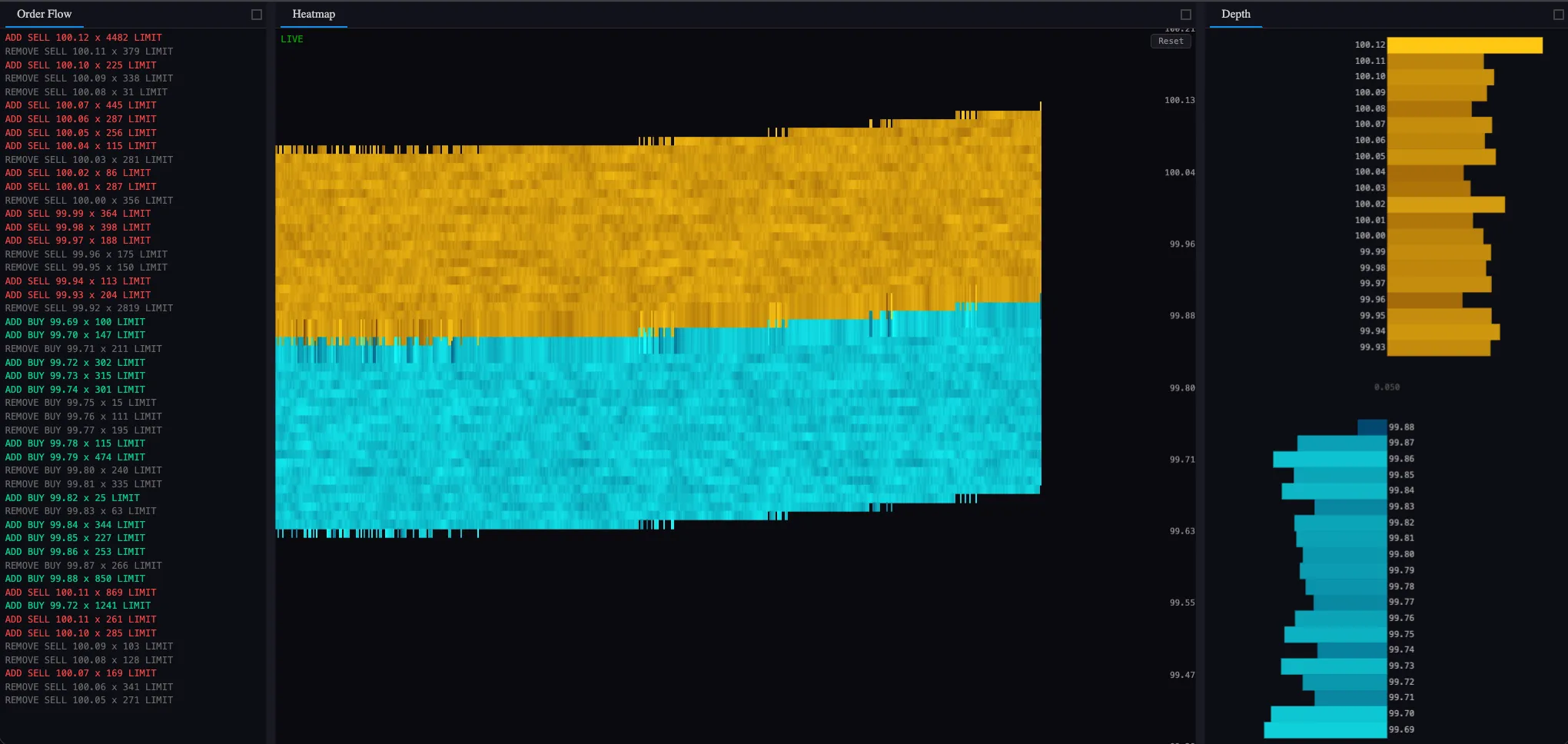
The browser client renders directly to a <canvas> element using pixel-level drawing (no charting library). Each column is a time slice, each row a price level. Pixel intensity maps to order quantity using sqrt scaling — this compresses the wide dynamic range of order sizes into a visible gradient.
- Bid levels: cyan channel
- Ask levels: orange channel
- Spread: dark gap between bid and ask bands
The viewport supports zoom, pan, and auto-follow mode (locks to the latest time slice). At typical update rates of 1-2 snapshots per second, the heatmap provides a readable view of how liquidity shifts around the spread.
Running It
Local development with Docker Compose:
docker-compose upThis starts NATS, the feeder, processor, and viz server. The UI is served on http://localhost:8080.
For a multi-node setup with Kind (Kubernetes in Docker):
cd infra && ./deploy.shThe deploy script creates a Kind cluster, installs NATS via Helm, and deploys all components with horizontal scaling on the processor.
Source code: github.com/NagyErvin-ZY/lob-proc